
A grill brick made of special abrasive materials is an essential cleaning tool for professional kitchens. Understanding its composition, safety, and manufacturing process helps operators and buyers select reliable, food-safe solutions for griddle and grill maintenance.
A grill brick made of foamed glass or vitrified abrasive materials is designed for commercial kitchen use, offering non-toxic, non-porous cleaning without damaging grill surfaces. Always verify food safety and supplier documentation before purchase.
What are commercial grill bricks made of?
A grill brick made of foamed glass aggregate or vitrified abrasive minerals is commonly used in foodservice environments. These bricks are manufactured to be non-toxic, non-porous, and safe for use on hot metal surfaces.
For commercial kitchens, the preferred material is foamed glass, sometimes called pumice glass or cellular glass. This material is produced by heating and expanding glass particles to create a lightweight, abrasive block. The resulting brick is effective for removing grease, carbon, and residue from griddles and grills without scratching or leaving harmful debris.
Key properties of commercial grill bricks:
Commercial grill brick composition?
Commercial grill brick composition typically centers on foamed glass aggregate, but some products may include other inert abrasives or bonding agents. The main ingredient is recycled glass, which is ground, mixed with a foaming agent, and then heated at high temperatures to expand and bond the particles.
A typical composition breakdown:
Buyers should always request a detailed composition sheet from the supplier, especially when purchasing for food-contact use or private label distribution.
Grill brick material safety data sheet?
A material safety data sheet (MSDS), sometimes called a Safety Data Sheet (SDS), is crucial for verifying the safety of a grill brick made of foamed glass or similar materials. The MSDS provides information on potential hazards, safe handling, and emergency procedures.
Key MSDS points for grill bricks:

Non toxic food safe grill brick?
Ensuring you source a non toxic food safe grill brick is essential for commercial kitchen safety and compliance. A grill brick made of foamed glass is generally recognized as non-toxic and safe for use on food-contact surfaces, provided it contains no added chemicals, colorants, or fillers.
Buyers should consider these factors:
| Feature | Why It Matters | Buyer Checklist |
|---|---|---|
| Foamed glass material | Non-toxic, inert, non-porous | Confirm with supplier |
| No added colorants | Avoids contamination risk | Check technical data sheet |
| Clean breakage | No sharp shards or splinters | Request product sample |
| Food-contact testing | Verifies suitability for kitchen | Ask for test report or declaration |
For distributors and private label buyers, sampling and third-party testing can help validate claims. Always confirm with your supplier that the grill brick made of foamed glass meets your safety requirements.
Grill brick manufacturing process?
The manufacturing process of a grill brick made of foamed glass involves several key steps to ensure consistency, safety, and performance:
- Raw Material Selection: High-quality recycled glass is selected and cleaned to remove impurities.
- Grinding: Glass is crushed into fine particles.
- Mixing: The ground glass is blended with a controlled amount of foaming agent (like carbon or organic powder).
- Molding: The mixture is placed into molds for shaping.
- Firing: Molds are heated in a kiln at high temperatures (typically 800–900°C). The foaming agent reacts, creating a cellular, lightweight structure.
- Cooling and Demolding: The bricks are cooled and removed from molds.
- Cutting and Finishing: Bricks are cut to size and edges are smoothed as needed.
- Quality Control: Each batch is inspected for structural integrity, consistency, and absence of sharp fragments.
- Packaging: Finished bricks are packed in bulk, shrink-wrapped, or boxed, depending on buyer requirements.
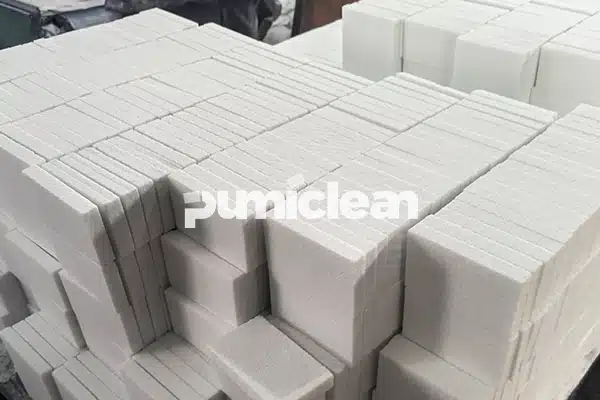
Manufacturers like HUAYUE Group offer various sizes, shapes, and packaging options. OEM/private label buyers can request custom branding, colors, or special sizes, subject to minimum order quantities.
FAQ
Q: What sizes are available for a grill brick made of foamed glass?
A: Common sizes include 8"x4"x3" and 6"x3"x3", but custom sizes are possible for bulk orders or private labeling.
Q: Can grill bricks be used on chrome or Teflon-coated griddles?
A: Grill bricks are best for steel or cast iron surfaces. Always test on a small area first and consult the equipment manufacturer.
Q: Are grill bricks reusable?
A: Yes, a grill brick made of foamed glass can be used multiple times until it wears down, making it cost-effective for busy kitchens.
Q: How should grill bricks be stored?
A: Store in a dry, clean area away from food and chemicals. Keep in original packaging to prevent contamination.
Q: What is the minimum order quantity (MOQ) for OEM buyers?
A: MOQ varies by supplier, but typically starts at 2,000–5,000 pieces for private label projects. Always confirm with your supplier.
Q: Do grill bricks require any special disposal?
A: No, as they are inert and non-toxic, used bricks can be disposed of with regular non-hazardous waste.
Conclusion
A grill brick made of foamed glass offers safe, effective cleaning for commercial kitchens. Always verify composition, safety data, and supplier reliability before purchase.


